
ActiveYards General Contractor in Fontana: A Homeowner’s Guide
ActiveYards fencing carries a lifetime warranty, but that warranty is voided by improper installation. The most common violation we see isn’t using the wrong panel or skimping on concrete. It’s setting posts in Fontana soil that needed compaction testing first, then watching the fence line warp within two seasons. Here’s what actually matters when you’re spec’ing and installing ActiveYards in this city.
What Makes ActiveYards Different From Big-Box Fencing
Most homeowners comparing fence quotes don’t realize there’s a structural difference between ActiveYards aluminum and the panels you’ll find stacked outside a home improvement warehouse. The distinction comes down to how the rails lock into the posts. ActiveYards uses a post-and-rail connection system with internal fasteners that require specific torque during install. Over-tighten and you stress the bracket. Under-tighten and the rail shifts, especially when Fontana’s afternoon winds push against a 6-foot panel run.
Big-box aluminum fencing typically uses thinner wall extrusions and external screws that back out over time. ActiveYards panels are extruded with a beefier wall profile, and the rails seat into routed post pockets rather than surface-mounting. That means fewer visible fasteners, less galvanic corrosion at the connection points, and a cleaner line across the top of the fence. For vinyl, the difference shows up in the rail reinforcement. ActiveYards vinyl rails carry internal aluminum stiffeners as standard on most residential lines. Cheaper vinyl systems leave a hollow rail, which sags over a 72-inch span, especially in Fontana’s summer heat when PVC softens.
The takeaway: you’re not just paying for a brand name. You’re paying for a connection system that holds tolerance and a rail that doesn’t bow. If you’re comparing quotes from a General Contractor in Fontana against a fencing-only installer, ask both how they handle ActiveYards torque specs. The answer tells you everything.
Fontana Soil and Why Post Depth Specs Matter More Here
ActiveYards publishes a standard spec sheet with recommended footing depths. The problem is that spec sheet assumes a generic soil condition, and Fontana’s residential neighborhoods don’t have generic soil. Much of the city sits on expansive clay that swells when it rains and shrinks when it dries. That expansion and contraction pushes against fence posts vertically and laterally. Put a post at the manufacturer’s minimum depth in unamended clay, and you’ll see frost-heave-style movement within two wet seasons, not because it freezes here but because the clay’s shrink-swell cycle acts the same way.
In practice, that means we’re often drilling footings deeper than the spec sheet calls for and adding a gravel drainage layer at the base of each post hole. The gravel gives water a path away from the post before it saturates the surrounding clay. For runs along the north side of Fontana, near the foothills where the soil transitions from clay to decomposed granite, we test the actual soil before setting the first post. A compaction test on a 40-foot run costs a few hundred dollars and tells us whether the native soil will hold or whether we need to over-excavate and backfill with compacted aggregate.
Most landscapers skip that step. They dig the hole, drop the post, pour the bag of quick-set, and move to the next post. The fence looks fine for 18 months. Then the gates start binding, and the line develops a visible wave. By then, the warranty claim gets denied because the installation didn’t follow best practice for the site conditions, and the homeowner is paying for a re-do.
Why Fencing, Hardscaping, and Gate Automation Need One Brain
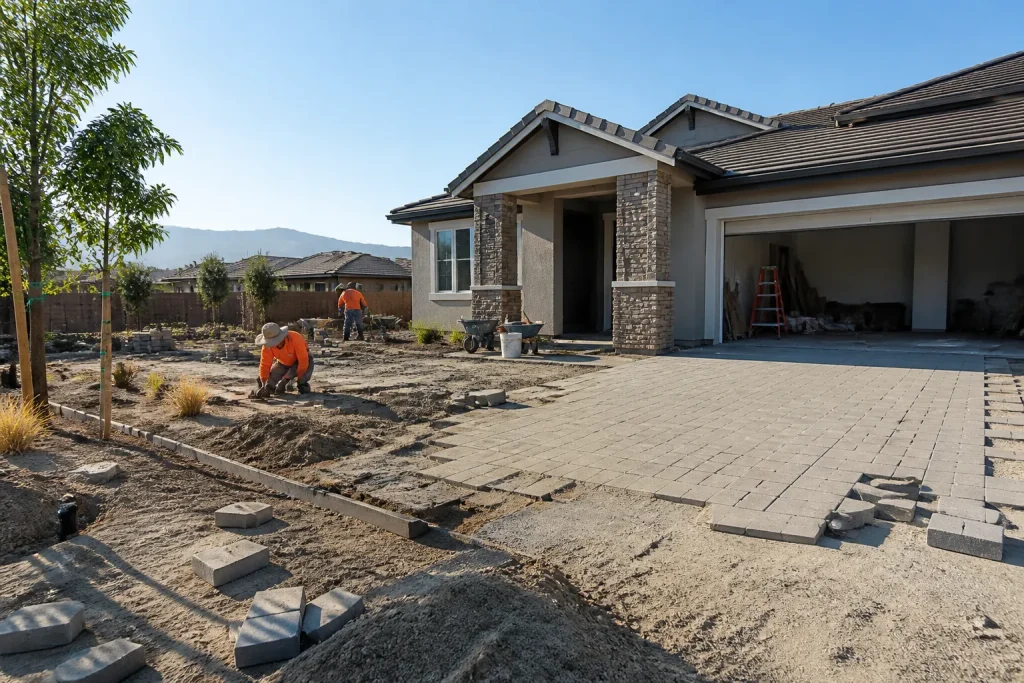
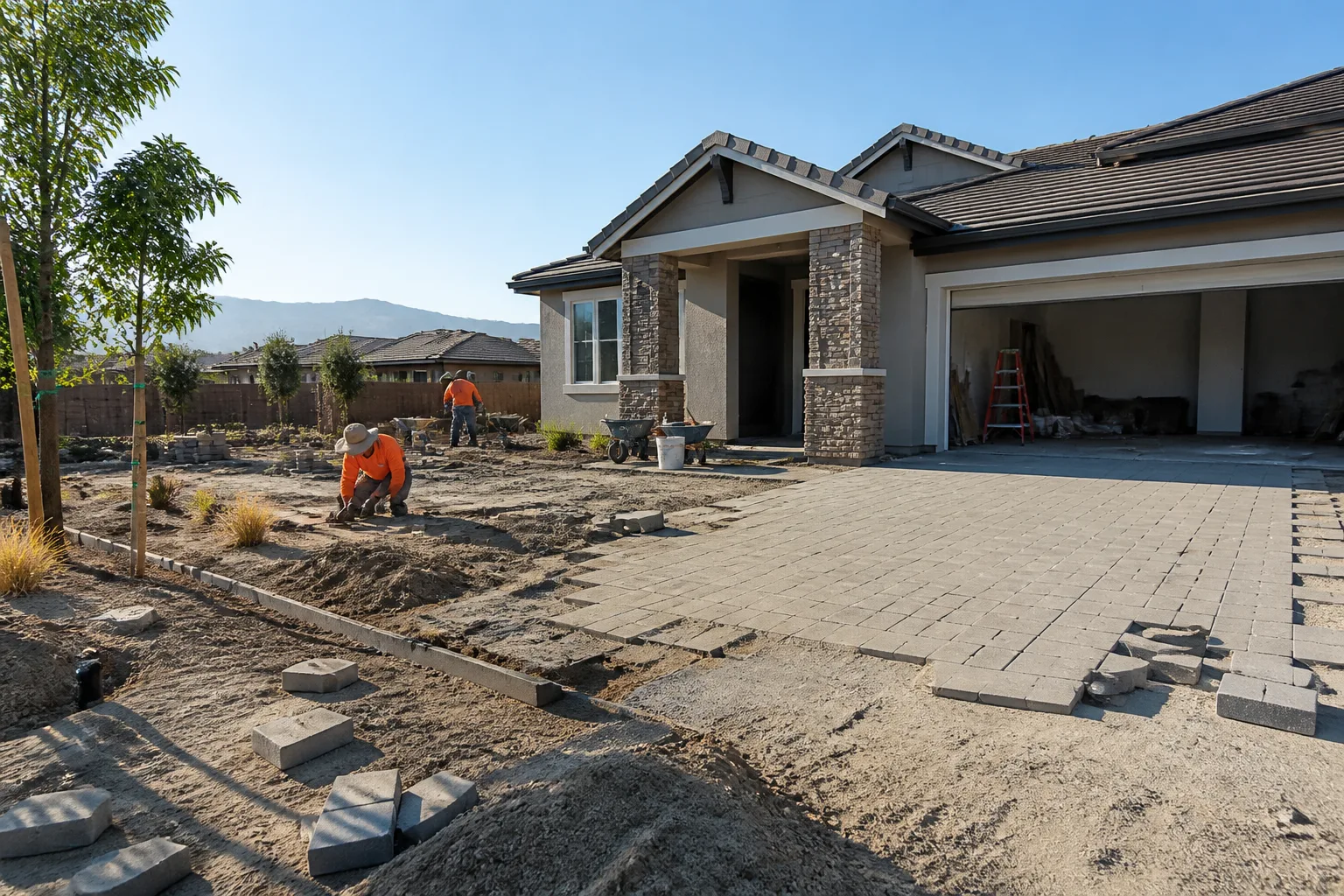
ActiveYards fencing rarely exists in isolation. In most Fontana backyards, the fence line meets a paver patio or a concrete walkway. That’s where fencing-only contractors create expensive problems. If the fence posts are set before the pavers go in, the hardscape crew has to cut around posts or, worse, the paver base shifts the grade and buries the bottom rail. If the pavers go in first, the fence crew has to core through the pavers to set footings, which cracks them.
A general contractor coordinates the sequence. We set fence posts after final grade is established but before pavers are compacted, so the post footings tie into the same compacted base the pavers will sit on. That sequencing matters for ActiveYards specifically because its gate hardware is designed to mount to a plumb post with a rigid connection to the ground. If the post shifts even half an inch after the pavers settle, the gate latch won’t line up, and you’re adjusting hinges every spring.
Gate automation adds another layer. Adding a BFT or LiftMaster operator to an ActiveYards gate requires a rough-in for low-voltage wiring, a dedicated GFCI circuit nearby, and often a vehicle loop detector cut into the driveway. A fencing contractor who doesn’t do electrical doesn’t think about the conduit stub-out before the concrete pour. Then the automation retrofit costs triple what the original rough-in would have. When we build an ActiveYards project in Fontana, we’re already thinking about the intercom wire, the keypad location, and whether the HOA requires a Knox box for emergency access.
Fontana Setback Rules, Heights, and HOA Reality
Fontana’s municipal code sets fence height limits based on location. Front yard fences typically cap at 42 inches, though that changes with corner-lot sight triangle requirements. Side and rear yard fences can go to 6 feet, and some cases allow 7 feet with a variance. Pools have their own rule set: a 60-inch minimum barrier with self-closing, self-latching gates, and no horizontal rails that act as a ladder on the exterior side. ActiveYards aluminum works well for pool barriers because the picket spacing meets the 4-inch sphere rule and the top rail is narrow enough that a child can’t get a toehold on it.
The less visible layer is the HOA. Many Fontana communities, especially the newer subdivisions south of the 210, have architectural review committees with specific fencing guidelines. Some require a specific ActiveYards style to match the rest of the street. Some only allow certain colors. Some won’t approve a fence until the plans show exactly where the posts fall relative to the property line, which means you need a survey, not just a guess.
We handle the submittal package: the survey, the ActiveYards spec sheet, the plot plan with post spacing marked, and the color sample chip. HOAs move slow, and a resubmittal sets the project back 30 to 60 days. Getting it right the first time is less a matter of expertise and more a matter of not skipping steps. The setback rules in Fontana also matter for ActiveYards because the post footings extend below grade. A fence built exactly on the property line puts the concrete footing partially on the neighbor’s side. Set it as close to the line as code allows without crossing it, and you’re fine. Cross it, and the neighbor has standing to force a removal.
Spec’ing ActiveYards Correctly So You Don’t Re-Order Mid-Project
The most avoidable delay on an ActiveYards job is a material re-order because something was measured wrong at the start. That costs time, freight, and in some cases a color lot mismatch when the new panels arrive from a different production batch. Here’s the spec checklist we work through before anything gets ordered:
- Panel style and height: ActiveYards offers multiple styles in both aluminum and vinyl. For front yards under 42 inches, we typically spec the Classic or Estate series with a lower picket count for visibility at driveways. For rear yard privacy, a 6-foot vinyl privacy panel with internal aluminum stiffeners holds up better than aluminum-alone in Fontana’s summer.
- Post spacing: ActiveYards panels are designed for specific post centers. Forcing an 8-foot panel onto 7-foot post centers means field-cutting and voiding the finish warranty at the cut point. We measure the run before ordering and break it into standard increments so the fence ends exactly where the house or retaining wall begins.
- Gate swing clearance: A 48-inch gate needs more than 48 inches of swing room. If the swing path crosses a sloped driveway or a paver step, the bottom of the gate catches. We account for the slope at the hinge post and, where necessary, spec a gate with an angled bottom or reverse the swing direction.
- Post caps and hardware finish: ActiveYards hardware is powder-coated, but the color has to match between components ordered on the same order. We spec every piece from one color code so the gate latch, hinges, post caps, and panels all come from the same production run.
- Wind load: Fontana’s Santa Ana wind events are a real structural consideration. For 6-foot runs on open exposures, we increase the post depth and sometimes upsize the post wall thickness from the standard spec. The cost difference is modest; a fence failure isn’t.
This is the work a homeowner shouldn’t have to do. But it helps to know what questions to ask any installer. If they can’t talk about post spacing, torque specs, and swing clearance, keep looking.
What ActiveYards Costs in Fontana: A Working Range
Actual pricing depends on panel style, footage, gate count, and soil conditions, but here’s what we’re seeing on current jobs around the city. These numbers are accurate as of early 2026 for typical residential installs:
| Line Item | Typical Range (Fontana) |
|---|---|
| ActiveYards aluminum panels, 4 ft high (per linear foot) | $45 – $70 installed |
| ActiveYards aluminum panels, 6 ft high (per linear foot) | $60 – $90 installed |
| ActiveYards vinyl privacy, 6 ft high (per linear foot) | $55 – $85 installed |
| Single walk gate with hardware | $700 – $1,200 |
| Double drive gate with hardware | $1,800 – $3,200 |
| Gate automation rough-in (wiring, conduit, post reinforcement) | $850 – $1,500 |
| Soil compaction testing | $300 – $600 per visit |
| HOA package prep and submittal | $250 – $500 |
The soil testing line item is the one most Fontana quotes don’t include. It’s also the one that determines whether your fence line stays straight. If you’d like a line-item quote that accounts for your specific yard and soil, Home Remodeling in Fontana projects often include fencing as part of the scope, and we quote the fence in the same document as the hardscape so there’s no scheduling conflict between trades.
The Bottom Line
ActiveYards is a better fence system than what most installers stock, but it only stays better if the install respects the material tolerances and the site conditions. In Fontana, that means deeper footings in expansive clay, a drainage layer under posts, torque-spec fastening on rail connections, and a sequencing plan that puts the fence in the right order relative to pavers, gates, and automation. A fencing-only contractor can deliver a fence. A general contractor delivers the fence, the hardscape, the gate wiring, and the HOA submittal as one coordinated job.
If you’re in Fontana and want a straight answer about ActiveYards pricing or whether your soil needs a compaction test, San Bernardino Contractors offers free estimates. Call (855) 473-5620 and we’ll walk your property line with you. See our San Bernardino Contractors home page for the full scope of what we handle, or read more about our Home Renovation in Fontana work if your project goes beyond the fence line.
Frequently Asked Questions
Multiple fencing contractors in Fontana work with ActiveYards, but not all are equipped to handle the full scope, which includes soil assessment, hardscape coordination, gate automation rough-in, and HOA submittal packages. San Bernardino Contractors handles ActiveYards installation as part of whole-home projects so the fence, pavers, and electrical work happen in the right sequence. Call (855) 473-5620 for a site walk and line-item quote.
Installed pricing in Fontana runs roughly $45 – $90 per linear foot depending on panel height, style, and aluminum versus vinyl. Gates add $700 – $3,200 each depending on width and automation. Soil testing adds another $300 – $600 if your property sits on expansive clay. For an exact number on your yard, we provide free estimates.
Yes, when installed with proper post depth and rail fastening. Vinyl panels with internal aluminum stiffeners resist sagging in high heat, and aluminum panels handle wind load better when posts are set deeper than the manufacturer’s minimum and the torque on rail connections is correct. Proper installation matters more than the material choice.
ActiveYards warranties cover material defects, not installation errors. Improper post setting, incorrect fastening, or field cutting that compromises the finish can void the warranty. Fontana’s expansive clay soil is a common reason for warranty denials, because the failure shows up as a warped line years after the install, and the manufacturer attributes it to site conditions rather than material defect.
Yes, and that’s the better way to do it. Coordinating the fence post footings with the paver base compaction avoids cutting around posts later and keeps the gate hardware rigid. San Bernardino Contractors manages both trades in one scope, with one schedule and one point of contact for the entire backyard.
Written by the team at San Bernardino Contractors, serving Fontana since 2015.
Need Construction Help?
Call San Bernardino Contractors — licensed & insured, here with fast after-hours help in San Bernardino.
(855) 473-5620